VO2 Max Training Plan: The Science of an 8-Week Program That Works
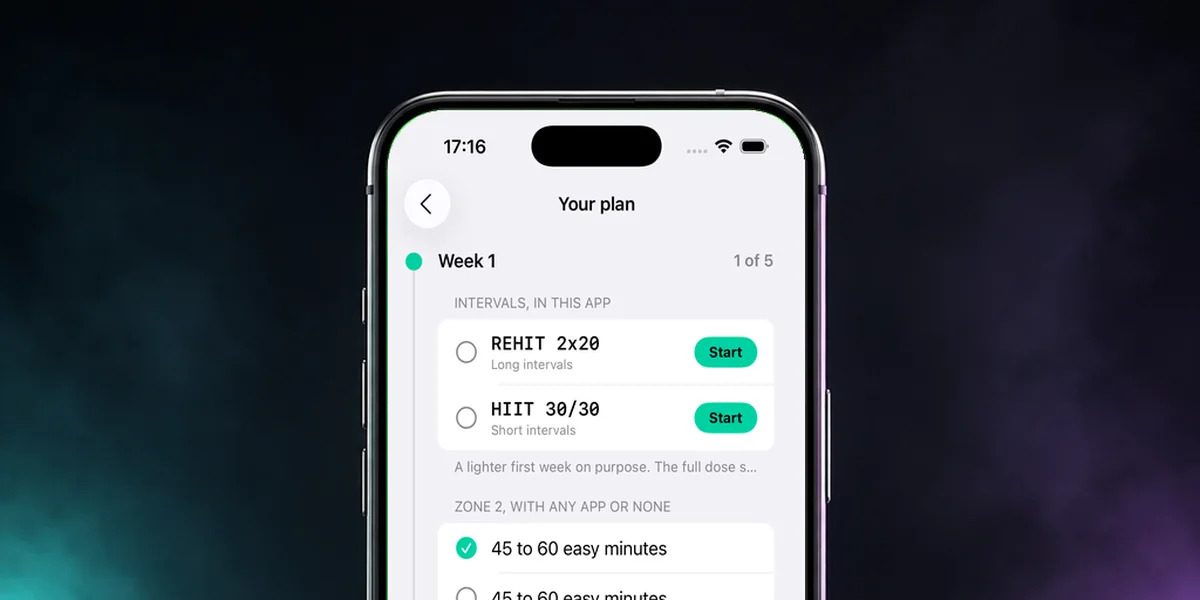
 Run these workouts on your iPhone, or hands-free on Apple Watch. Get PEAKVO2
 A VO2 max training plan works when it gets three things right: hard intervals at 90 to 95 percent of maximum heart rate, an easy aerobic base underneath them, and weeks that undulate with a deload and a taper rather than grinding the same load flat. Done that way, 8 weeks reliably raises VO2 max. PEAKVO2 builds exactly this into a research-grounded 8-week plan, and week 1 is free to try.
Most "VO2 max training plans" online are just a list of hard workouts. That is the easy part. The science of a plan that actually works is in the structure: how hard, how often, and crucially how the weeks change over time. This article covers that science, and the plan we built from it. For what your score means first, see our VO2 max charts by age and sex.
What a VO2 Max Plan Has to Get Right
Three principles decide whether a plan raises your number or just tires you out.
- Intensity, not volume. VO2 max gains come from time spent near your maximum. In the foundational trial, four intervals of 4 minutes at 90 to 95 percent of maximum heart rate, three times a week for 8 weeks, beat both moderate continuous training and threshold training for VO2 max (Helgerud et al., 2007). A meta-analysis of controlled trials confirmed intervals raise VO2 max more than steady-state work (Milanovic et al., 2015).
- Accumulate time at the ceiling with short intervals too. Alternating 30 seconds hard with 30 seconds easy lets you stay at or near your VO2 max far longer than one continuous effort, and it feels more sustainable (Billat et al., 2000). Pairing a long-interval day with a short-interval day is a well-documented weekly structure.
- Build the base easy. The roughly 80/20 split, most training easy and a little hard, popularized by Stephen Seiler, is what lets the hard sessions land. Two easy Zone 2 sessions a week is the consensus dose, and general guidance from the ACSM and WHO adds at least one strength session for overall health.
Two hard rules follow: no more than two hard interval sessions a week, at least 48 hours apart, and beginners should start with a single, gentler session, because the ACSM cautions explicitly against heavy intervals for people just starting out.
Why the Weeks Should Change
Here is the part almost every DIY plan misses. Holding the same hard load every week is not the safe option; it is the risky one.
In a randomized controlled trial of male recreational runners, undulating the weekly aerobic load improved oxygen supply and metabolism while reducing muscle-injury markers, whereas constant linear loading did not (Costa et al., 2019). And in triathletes, a structured, non-linear periodization compared with traditional linear loading helped avoid overreaching and preserved parasympathetic balance, so athletes arrived at their target fresh (Clemente-Suárez et al., 2019).
A counterintuitive point makes this work: the interval prescription itself does not need to get harder. Because the target is relative, a percentage of your maximum heart rate, the same 90 percent forces a higher absolute pace or power as you get fitter. Progression is built into the intensity, not bolted on with bigger numbers. So the weeks are shaped for recovery and peaking, not escalation:
| Phase | Weeks | What it does |
|---|---|---|
| Ramp-in | 1 | A lighter first week so the habit forms before the full dose |
| Standard | 2 to 3 | The full weekly dose: a long-interval day, a short-interval day, easy base, strength |
| Deload | 4 | The second hard day drops and easy volume rises, the RCT's recovery week |
| Progression | 5 to 7 | The long-interval protocol steps up and the short format rotates |
| Peak and test | 8 | One hard day, then a fitness test on fresh legs to measure the gain |
This is the structure, not a copy-and-run schedule, because the exact sessions depend on your current fitness. That is the job of the plan below.
The PEAKVO2 8-Week Plan
We built all of the above into PEAKVO2 as a research-grounded 8-week plan. It is designed around one idea: a plan should prescribe a week, not a calendar. Instead of dated workouts you can "miss", you get a short quota of tickable rows for the week, so the plan never guilt-trips you, it just tracks what is still open.
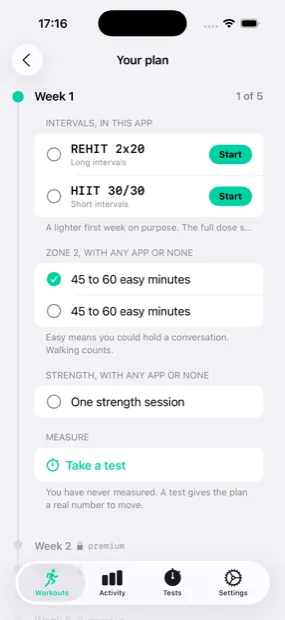
Each week holds five things:
- Long intervals, run in the app: the Norwegian 4x4 or a step along the protocol ladder, matched to your fitness.
- Short intervals, run in the app: 30/30, Tabata, or a REHIT sprint session.
- Two Zone 2 sessions, 45 to 60 easy minutes, logged with any app or none.
- One strength session, with any app or none.
- A fitness test at the end of the arc, because week 8 pays off the promise of getting measurably fitter.
The plan is honest about what it controls: it runs and judges your interval sessions against the 85 to 95 percent heart rate band that characterizes the 4x4 (Acala et al., 2020), and it prescribes the Zone 2 and strength work plainly as external. It is also beginner-safe: if you are new or unmeasured, it gives you one gentler interval slot, not two. And it adapts, the week 8 test can move your fitness band, which changes the protocol you are prescribed next. The plan reacts to your result instead of repeating itself.
Week 1 is free. You can start the plan and run the first week's interval sessions without paying, so you can feel how it works. Weeks 2 through 8, which add the periodization, deload, progression, and taper, are part of PEAKVO2 premium.
One honest caveat, the same one the app makes: the 7 to 13 percent improvement is a study population's range, not a personal guarantee. What the plan gives you is the structure the research says produces that result.
How Hard Should the Intervals Feel?
The hard intervals should feel like an 8 to 9 out of 10: you can get a word or two out but not a sentence, and you could not hold the pace much past the interval. In heart rate terms that is 85 to 95 percent of your maximum. If you do not know your zones, use the max heart rate calculator to set them. The recovery portions should be genuinely easy, around 60 to 70 percent, so the next hard effort stays productive.
Track the Number and Retest
You cannot manage what you do not measure. Your Apple Watch or Garmin estimates VO2 max from outdoor runs, and a field test gives a direct check. Leave 6 to 8 weeks between real tests, because shorter gaps show day-to-day noise, not adaptation. That is exactly why the plan ends in a test at week 8.
Common Mistakes
- Grinding the same load every week. Without a deload, you accumulate fatigue and injury risk instead of fitness. Undulate and recover.
- Too many hard days. Two interval sessions is the ceiling. A third does not speed things up; it slows you down.
- Testing too often. A test every couple of weeks measures noise. Test at the start and after the 8-week arc.
- Skipping the easy base. If your easy days creep up in intensity, your hard days suffer. Keep Zone 2 slow enough to hold a conversation.
Start the plan free in PEAKVO2
The research-built 8-week plan, with long and short intervals guided on iPhone and Apple Watch, heart rate zones, and a fitness test to prove the gain. Week 1 is free, no subscription to try it.
Get PEAKVO2 freeKeep Reading
- Norwegian 4x4 Protocol: Proven HIIT to Raise VO2 Max
- Norwegian 4x4 Training Plan: Week-by-Week Guide
- 30/30 Interval Training: The 30-Second Workout for VO2 Max
- How to Improve Your VO2 Max
- VO2 Max by Age: Chart of Normative Scores and What's Good
References
- Helgerud J, Høydal K, Wang E, et al. Aerobic high-intensity intervals improve VO2max more than moderate training. Med Sci Sports Exerc. 2007;39(4):665-671. PubMed
- Billat VL, Slawinski J, Bocquet V, et al. Intermittent runs at the velocity associated with maximal oxygen uptake enables subjects to remain at maximal oxygen uptake for a longer time than intense but submaximal runs. Eur J Appl Physiol. 2000;81(3):188-196. PubMed
- Milanović Z, Sporiš G, Weston M. Effectiveness of High-Intensity Interval Training (HIT) and Continuous Endurance Training for VO2max Improvements: A Systematic Review and Meta-Analysis of Controlled Trials. Sports Med. 2015;45(10):1469-1481. PubMed
- Costa P, et al. A Randomized Controlled Trial Investigating the Effects of Undulatory, Staggered, and Linear Load Manipulations in Aerobic Training on Oxygen Supply, Muscle Injury, and Metabolism in Male Recreational Runners. Sports Med Open. 2019;5:32. PubMed
- Clemente-Suárez VJ, et al. Effectiveness of Reverse vs. Traditional Linear Training Periodization in Triathlon. Int J Environ Res Public Health. 2019;16. PubMed
- Acala JJ, et al. Characterizing the Heart Rate Response to the 4 × 4 Interval Exercise Protocol. Int J Environ Res Public Health. 2020;17. PubMed
- Seiler S. What is best practice for training intensity and duration distribution in endurance athletes? Int J Sports Physiol Perform. 2010 (the 80/20 intensity distribution).